While physicists and astronomers discuss about the larger scheme of things like the Big Bang, the formation of the universe, and laws of physics that define movement through time and space, it is troubling to say that being within our own galaxy, scientists have been having a difficult time even grasping the shape of the Milky Way.
In the 1950s, astronomers produced the map of our galaxy based off radio observations of gas. Such studies suggest that the Milky Way is made of four major spiraling arms.
Image Source
The four major arms were Norma, Scutum-Crux, Sagittarius, Persues, while our Solar System is located on a "small, partial" arm called the Orion. For decades, astronomers have produced the structure of the milky way based only on radio signals.
By the 1990s, the use of infrared telescopes became the accepted form of mapping the Milky Way since infrared could penetrate dust and thus have better resolution in crowded sectors of our galaxy. However, such use of infrared observations have overthrown many preconceptions of the structure of the galaxy!
In 2008, A team of scientists using the Spitzer Infrared Space Telescope showed that the Milky Way had two major arms instead of four!
Image Source
"These major arms, the Scutum-Centaurus and Perseus arms, have the greatest densities of both young, bright stars, and older, so-called red-giant stars. The two minor arms, Sagittarius and Norma, are filled with gas and pockets of young stars. Benjamin said the two major arms seem to connect up nicely with the near and far ends of the galaxy's central bar."
For additional information and curiosity of the minor arms, Far/Near 3kpc, please view this link.
However, that was what NASA said in 2008. In 2009, another group of scientists used Very Long Baseline Array (VLBA) and revitalized the previous concepts that the Milky Way Galaxy has four arms instead of two.
VLBA is "a system of 10 radio-telescope antennas stretching from Hawaii to New England and the Caribbean, provides the best ability to see the finest detail, called resolving power, of any astronomical tool in the world. The VLBA can routinely produce images hundreds of times more detailed than those produced by the Hubble Space Telescope," and thus making the claim these scientists are trying to assert, as the most recognized idea of the structure of the Milky Way Galaxy yet.
To more understand this competing theory, please click here.
Yet, another group of scientists based off Brazil by 2010 are starting to claim that the Milky Way Galaxy may in fact be a square instead of the circular shape previous scientists have conceived of its structure as.
Their data which is built upon the 2008 VLBA study shown above, indicates that many parts of the 'spirals' didn't neatly circle the galactic center, but were in fact straight.
Although not the first group of scientists to claim this, this group of scientists also believe that their data shows that the Milky Way Galaxy is composed of not two or four arms, but three!
To understand more about these Brazilian scientist's standpoints, click on this link.
This long, messy pursuit of knowledge of how our galaxy looks like from another galaxy's point of view illustrates science perfectly, as competing theories continue to grow to seek more support until one theory is agreed upon by the majority of astronomers. Unfortunately for the time being, it would seem that the shape and size of the Milky Way Galaxy, our own tiny backyard within the almost infinite universe, remains uncertain.
Thursday, October 14, 2010
Friday, September 24, 2010
The Mystery of Gamma Ray Bursts Uncovered - Please View Clips from Top to Bottom!
Massive Gamma Ray bursts in space have baffled scientists for decades due to the unprecedented explosive power observed and inconceivable mass required to generate such phenomenons. The following movies show the unraveling of this mystery through the use of laymen's terms!
This phenomenon was discovered 40 years ago, and has remained a mystery until NASA managed to obtain the technology and knowledge to record the 'afterglow' of gamma ray bursts on May 9th, 2005. (If you don't understand, then obviously you have't watched the cool movies yet!)
http://www.nasa.gov/mission_pages/swift/bursts/short_burst_oct5.html
This phenomenon was discovered 40 years ago, and has remained a mystery until NASA managed to obtain the technology and knowledge to record the 'afterglow' of gamma ray bursts on May 9th, 2005. (If you don't understand, then obviously you have't watched the cool movies yet!)
http://www.nasa.gov/mission_pages/swift/bursts/short_burst_oct5.html
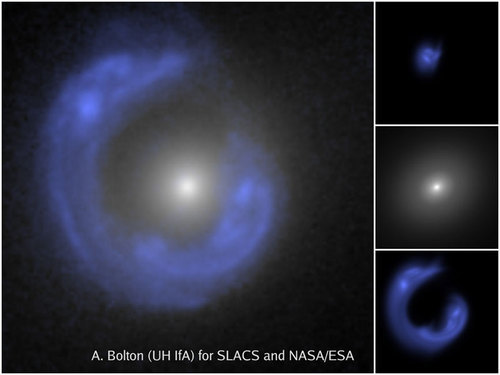
Einstein Rings
A pretty cool, in fact rare phenomenon, there are only 11 Einstein Rings found by the Hubble Telescope by 2006. This phenomenon occurs when light from a distant galaxy is bent by another galaxy closer to Earth, causing the light from the more distant galaxy to form a bright 'ring' around the closer galaxy!
In fact, at 2008, the Hubble Space Telescope uncovered a DOUBLE Einstein Ring, where two rings from different galaxies can be seen around one closest galaxy!
http://www.sciencedaily.com/releases/2008/01/080110102319.htm
To find out how Einstein Rings work, and more information on the fact on how Einstein predicted these rings around 70-80 years ahead of our time (hence the term Einstein Rings), check out this site:
http://www.sciencedaily.com/videos/2006/0408-einstein_rings.htm ---> with a short movie
In fact, at 2008, the Hubble Space Telescope uncovered a DOUBLE Einstein Ring, where two rings from different galaxies can be seen around one closest galaxy!
http://www.sciencedaily.com/releases/2008/01/080110102319.htm
To find out how Einstein Rings work, and more information on the fact on how Einstein predicted these rings around 70-80 years ahead of our time (hence the term Einstein Rings), check out this site:
http://www.sciencedaily.com/videos/2006/0408-einstein_rings.htm ---> with a short movie
Sunday, September 19, 2010
Replacement of Hubble, and Planned Building of Largest Telescope on the Ground
Hubble has been in service for approximately 20 years, and is expected to be in service for another 4 years until its replacement, James Webb Space Telescope (JWST) is sent into orbit.
The Hubble Space Telescope orbits the Earth around 600 kilometers out in space. In comparison, JWST is planned to be around 1.5million kilometers out in space. One of the reasons why the Hubble Space Telescope was placed so close to the surface of the Earth, is due to the fact that it was planned to be maintained once every several years by Space Shuttle crews. With 5 Space Shuttle missions being sent to the Hubble Space Telescope specifically meant to maintain and replace vital equipment, this has allowed Hubble to remain in service for 20 years already. Whereas, JWST is planned to have 10 years of operational time.
From JWST's shear mirror mass, it may provide support for the big bang since it can literally look back in time to find the origin of the universe.
For more information on JWST, please take a peek at these awesome sites:
http://news.bbc.co.uk/2/hi/americas/6645179.stm
http://www.jwst.nasa.gov/
http://www.physorg.com/news90084957.html
Back on the surface, the largest optical telescope operating is located in La Palma, Canary Islands, Spain with an aperture of 10.4 meters. Although it is larger than JWST, it is a well known fact that telescopes in space capture much more detailed pictures than any telescope on the ground.
However, the largest optical telescope being planned/built is located in Chile, where it is planned to have an aperture of 42 meters, or 138 feet! Named as the European Extremely Large Telescope (E-ELT), it is expected to begin construction this year, and may become fully operational by 2018.
For more information on this, search for this yourself, or please take a look here:
Subscribe to:
Posts (Atom)